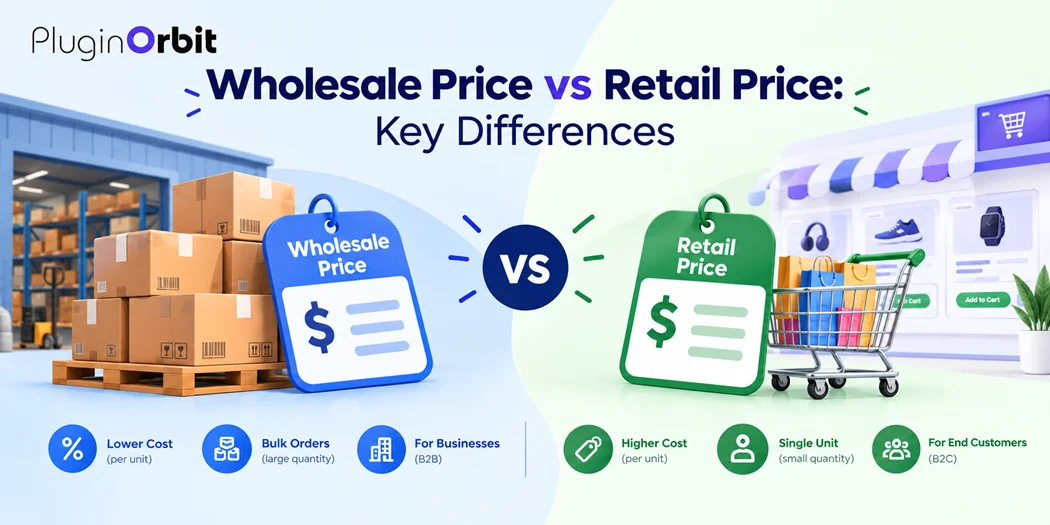
Wholesale and retail prices affect how businesses buy products, sell to customers, and earn a profit. If you run an online store, understanding the difference between these two pricing methods can help you set competitive prices, manage costs, and make better business decisions.
The main difference is that wholesale prices are generally offered to businesses buying products in larger quantities, while retail prices are the prices customers pay when purchasing products for personal use. However, the actual pricing structure depends on the supplier, product, order quantity, and business agreement.
In this guide, we will explain wholesale price vs retail price, compare their key differences, provide practical examples, and show how WooCommerce store owners can approach wholesale and retail pricing.
What Is Wholesale Price?
A wholesale price is the amount a supplier, manufacturer, or distributor charges when selling products to another business, often in larger quantities.
Retailers purchase products at wholesale prices so they can resell them to customers. The difference between their selling price and the total cost of acquiring and selling the products contributes to their gross profit.
For example, a clothing retailer might purchase 100 T-shirts from a supplier at $8 per shirt. The retailer could then sell each shirt for $20, depending on market demand, operating costs, and its pricing strategy.
Wholesale prices are not always the same for every buyer. Suppliers may offer different prices based on order volume, customer agreements, product specifications, or purchasing frequency.
Key Characteristics of Wholesale Pricing
Larger order quantities: Wholesale transactions often involve bulk purchases.
Lower per-unit prices: Suppliers may reduce the unit price when customers order more products.
Business customers: Buyers are commonly retailers, distributors, resellers, or other organizations.
Negotiated pricing: Some suppliers provide special rates to regular customers or large accounts.
Minimum order requirements: Certain wholesalers require customers to purchase a minimum quantity or order value.
Wholesale pricing can work well for businesses that need inventory for resale or regular operations. However, buyers should consider storage, shipping, handling, and inventory risks before placing large orders.
What Is Retail Price?
A retail price is the amount a business charges the final customer for a product. It is the price displayed on a product page, store shelf, or online shopping website.
Retailers typically set their prices after considering the purchase cost, operating expenses, competitor prices, customer demand, and desired profit margin.
For example, a retailer that buys a water bottle for $6 might sell it for $15. The $9 difference is the gross profit per bottle before other expenses, assuming the $6 represents the full product cost.
Retail prices can change because of seasonal promotions, discounts, product demand, brand positioning, or competition.
Key Characteristics of Wholesale Pricing
Individual purchases: Customers can often buy one product without meeting a minimum quantity.
Customer-facing prices: Retail prices are generally displayed publicly.
Higher per-unit prices: Retail prices are often higher than wholesale prices for the same product.
Convenience: Customers pay for easy access to products, customer service, and the shopping experience.
Promotional flexibility: Retailers can use coupons, seasonal sales, bundles, and loyalty offers.
Retail pricing is common in online stores, supermarkets, clothing shops, electronics stores, and direct-to-consumer businesses.
Wholesale Price vs Retail Price: Key Differences
Although both pricing methods involve selling products, they serve different purposes.
| Factor | Wholesale Price | Retail Price |
| Typical buyer | Retailers and other businesses | Individual consumers |
| Order quantity | Often larger | Often smaller |
| Price per unit | Generally lower | Generally higher |
| Main purpose | Resale or business use | Personal consumption |
| Pricing structure | May include volume discounts | Usually a displayed selling price |
| Minimum order | May be required | Usually not required |
| Profit approach | Often depends on order volume | Often depends on per-unit margin and sales volume |
| Customer relationship | Often ongoing business relationships | May involve individual purchases or repeat customers |
These are general differences rather than universal rules. Some retailers offer bulk discounts to consumers, and some wholesale suppliers sell smaller quantities at standard rates.
Why Is Wholesale Pricing Usually Lower?
Wholesale buyers often purchase multiple units in one transaction. Larger orders can help suppliers distribute production, packaging, and fulfillment costs across more products.
For example, a supplier selling 500 notebooks to a retailer may be able to offer a lower unit price than it would for a single notebook.
However, a lower price is not guaranteed simply because a customer purchases in bulk. Product availability, supplier costs, customization, shipping, and negotiated agreements can all influence the final price.
Retail prices generally include the retailer’s product cost plus the expenses associated with running the business and serving customers.
Wholesale vs Retail Price: A Practical Example
Imagine a business that sells reusable water bottles.
The supplier sells the bottles to retailers for $6 each when they purchase a qualifying quantity. A retailer then sells each bottle for $15.
Here is how the basic calculation works:
| Item | Amount |
| Wholesale purchase price per bottle | $6 |
| Retail selling price per bottle | $15 |
| Difference per bottle | $9 |
| Quantity purchased | 100 |
| Total wholesale product cost | $600 |
| Total sales if all 100 sell at $15 | $1,500 |
| Gross profit before other costs | $900 |
In this example, the retailer generates $900 in gross profit before deducting other expenses.
Those expenses may include shipping, packaging, payment processing, advertising, storage, employee wages, returns, and applicable taxes.
The $9 difference is not the same as net profit. Understanding this distinction helps retailers avoid setting prices that look profitable but fail to cover the actual cost of doing business.
How to Calculate Wholesale and Retail Prices
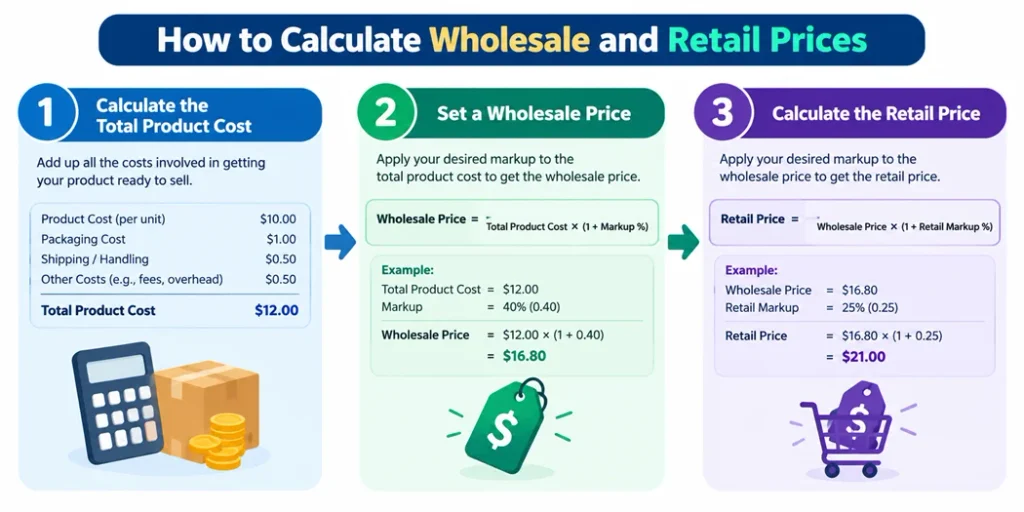
Before choosing a selling price, businesses should understand their costs and decide how they want to position their products in the market.
1. Calculate the Total Product Cost
Start by identifying the costs associated with purchasing or producing the product.
Depending on the business, these may include:
- Supplier or manufacturing cost
- Inbound shipping
- Packaging
- Import duties, where applicable
- Other costs directly associated with acquiring the product
For example, if a product costs $8 and inbound shipping adds $1 per unit, the product’s landed cost is $9 per unit before other business expenses.
2. Set a Wholesale Price
A wholesale price should cover the supplier’s relevant costs and provide a sustainable margin.
Suppose a manufacturer has a unit cost of $5 and sells the product wholesale for $8.
The gross profit is $3 per unit before other expenses.
The gross margin is calculated as:
Gross margin = (Selling price − Cost) ÷ Selling price × 100
In this example, the gross margin is 37.5%.
Businesses should calculate margins using realistic costs rather than relying only on a desired markup.
3. Calculate the Retail Price
Retailers should consider the wholesale purchase price, additional costs, competitive conditions, and the margin they want to achieve.
For example, if a product’s total unit cost is $10 and the retailer wants a 40% gross margin, the selling price can be calculated as:
Retail price = Total unit cost ÷ (1 − Desired gross margin)
Retail price = $10 ÷ (1 − 0.40) = $16.67.
The retailer would need to sell the product for approximately $16.67 to achieve a 40% gross margin before other costs not included in the $10 unit cost.
Markup and margin are different. A 40% markup on a $10 cost produces a $14 selling price, whereas a 40% gross margin requires a $16.67 selling price.
What Is WooCommerce Wholesale Pricing?
WooCommerce wholesale pricing refers to the pricing approach used by online stores that sell products to both wholesale customers and regular retail shoppers, or primarily to business buyers.
A store might display a standard retail price to the public while offering eligible wholesale customers a different price based on their account, purchase quantity, or agreed terms.
For example, a store could sell one product for $25 to retail customers and offer approved business customers a price of $18 per unit when they purchase 50 or more units.
These figures are illustrative. Actual prices should reflect the store’s costs, customer agreements, and business goals.
Store owners should decide how wholesale customers qualify for special pricing, whether minimum quantities apply, and how discounts interact with coupons, shipping, and other promotions.
How WooCommerce Bulk Pricing Works
WooCommerce bulk pricing means adjusting product prices or discounts according to the quantity purchased.
For example:
| Quantity purchased | Price per unit |
| 1–9 units | $20 |
| 10–49 units | $18 |
| 50 or more units | $16 |
This example shows a tiered pricing structure in which the unit price decreases as the order quantity increases.
Bulk pricing can encourage larger orders, but the discount should not reduce the margin below a sustainable level.
A store owner should also decide whether bulk discounts apply to all customers or only to approved wholesale accounts. These are separate rules, and not every store needs both.
If you are evaluating tools for your store, our guide to WooCommerce plugins explains how extensions can add functionality to an online store. Choose a solution based on the specific pricing features you need, and verify that it supports your intended pricing rules before installing it.
How Wholesale Pricing Relates to B2B and B2C Ecommerce
Wholesale pricing is commonly associated with B2B ecommerce, where one business sells products to another business. Retail pricing is more commonly associated with B2C ecommerce, where businesses sell directly to individual consumers.
However, these models can overlap. A WooCommerce store may serve business buyers and individual customers from the same website.
For example, a stationery supplier might sell individual notebooks to consumers while providing discounted case quantities to offices and retailers.
The store may need different purchasing options, customer accounts, order quantities, or pricing rules for each group.
If you want to understand how these customer relationships differ, read our guide to B2B vs B2C ecommerce. It explains how customer types influence purchasing decisions, pricing, and website requirements.
Understanding your business model first can help you decide whether standard retail pricing, wholesale pricing, or a combination of both is suitable for your store.
When Should You Use Wholesale Pricing?
Wholesale pricing can be useful when your business sells products to retailers, distributors, resellers, or organizations that purchase regularly.
It may be a good fit when:
- Customers need large quantities of the same product.
- You want to build recurring relationships with business buyers.
- Larger orders reduce your per-unit fulfillment costs.
- Your products are suitable for resale.
- You can offer volume discounts without damaging profitability.
Wholesale pricing also requires careful planning. Large orders can tie up inventory, and offering excessive discounts may leave too little profit to cover operating expenses.
Businesses should review their costs, cash flow, minimum order quantities, and customer payment terms before introducing a wholesale program.
When Should You Use Retail Pricing?
Retail pricing is suitable for businesses that sell directly to consumers or customers who want to purchase individual products.
It can work well when customers value convenience, product availability, delivery, customer support, and a straightforward checkout experience.
Retail pricing may be appropriate when:
- Customers typically buy one or a few products.
- You sell directly through an online store.
- You want to display clear prices to all shoppers.
- Your business relies on product presentation and customer experience.
- You can set prices that cover costs while remaining competitive.
Some retailers also offer bulk discounts to encourage larger consumer orders. The best approach depends on customer behavior, product economics, and your overall pricing strategy.
Wholesale Pricing for Dropshipping Businesses
Wholesale pricing can also matter to businesses that use dropshipping. In this model, a retailer sells products online while a supplier generally stores and ships the products directly to customers.
The retailer’s purchase cost, shipping charges, supplier terms, and other expenses all affect the price it needs to charge.
Unlike a traditional wholesaler that buys and stores inventory, a dropshipping retailer may purchase products from a supplier only after receiving a customer order.
This can reduce the need to hold inventory, but it does not guarantee higher profit margins. Supplier prices, shipping costs, competition, and advertising expenses can make profitability challenging.
For more detail, read our guide to WooCommerce dropshipping, which explains how the model works and what store owners should consider before getting started.
How Can a WooCommerce Store Handle Custom Wholesale Quotes?
Not every wholesale order can be priced using a fixed discount. Some businesses need to consider product customization, delivery requirements, order size, or negotiated agreements before providing a final price.
In these situations, a quotation process may be more suitable than displaying a single wholesale price for every buyer.
For example, a customer requesting 500 customized products may need to provide specifications before the seller can calculate the final cost.
A WooCommerce quote request form can collect information such as product selection, quantity, company details, and additional requirements. The store can then review the request and respond with an appropriate quotation.
If this matches your business needs, read our guide on how to create a WooCommerce quote request form.
A quote workflow is particularly useful when prices depend on individual requirements. For standard products with predictable costs, a clearly displayed price or quantity-based discount may be simpler for customers.
Conclusion
Understanding wholesale price vs retail price helps businesses choose a pricing strategy that fits their customers, costs, and sales model.
Wholesale pricing is generally designed for business buyers and larger orders, while retail pricing serves customers purchasing individual products. Understanding different eCommerce business models can help you choose the right pricing strategy for your target customers. Both approaches require careful cost calculations, competitive pricing, and a clear understanding of profit margins.
For WooCommerce store owners, the right approach may be standard retail pricing, wholesale pricing, quantity-based discounts, or custom quotations for larger orders.
Start by calculating your true product costs, identifying your target customers, and deciding how you want to handle different order sizes. With a well-planned pricing structure, you can make informed decisions while creating a clearer buying experience for your customers.