Choosing the right ecommerce platform can affect how easily you manage products, customize your store, handle payments, improve SEO, and scale your business. Two of the most widely considered options are WooCommerce and Shopify. While both can help you build and grow an online store, they take very different approaches.
WooCommerce works with WordPress and gives you extensive control over your store, hosting, design, and functionality. Shopify is a hosted ecommerce platform that brings hosting, store management, checkout, and many ecommerce tools together in one system.
So, Shopify or WooCommerce, which one should you choose? The answer depends on your budget, technical experience, customization needs, and how much control you want over your website.
In this WooCommerce vs Shopify comparison, we’ll look at pricing, features, ease of use, customization, SEO, security, scalability, and other important factors to help you choose the right platform for your store.
WooCommerce vs Shopify: Quick Comparison
| Feature | WooCommerce | Shopify |
| Platform type | WordPress ecommerce plugin | Hosted ecommerce platform |
| Hosting | Separate hosting required | Hosting included |
| Setup | More configuration | Easier to get started |
| Customization | Highly flexible | Flexible within Shopify |
| Maintenance | More hands-on | Mostly managed |
| Plugins/Apps | WooCommerce extensions and WordPress plugins | Shopify apps |
| SEO control | Extensive | Strong built-in capabilities |
| Best for | Control and customization | Simplicity and convenience |
The biggest difference is how each platform is managed. WooCommerce gives you more control over the underlying website, while Shopify handles much of the technical infrastructure for you.
What Is WooCommerce?
WooCommerce is an ecommerce platform built as a plugin for WordPress. Instead of creating a store on a separate hosted platform, you add ecommerce functionality to an existing WordPress website.
This approach gives store owners considerable control over their website. You can choose your hosting provider, customize your theme, install plugins, modify code, and add extensions according to your requirements.
WooCommerce can be particularly useful if you already use WordPress or want your ecommerce store and content marketing strategy to operate within the same ecosystem.
The trade-off is that you have more responsibilities. Hosting, updates, backups, security, plugin compatibility, and performance optimization may require your attention or the help of a developer.
If you’re already comparing the roles of these platforms with WordPress itself, understanding WooCommerce vs WordPress can help clarify that WordPress is the website and content management system, while WooCommerce adds ecommerce functionality.
What Is Shopify?
Shopify is a hosted ecommerce platform designed specifically for building and managing online stores. Hosting and much of the technical infrastructure are handled by Shopify, so you don’t need to purchase separate web hosting to launch your store.
This makes Shopify attractive to business owners who want to focus more on products, customers, marketing, and sales instead of server management and technical maintenance.
Shopify also provides themes, ecommerce features, payment options, analytics, and an app ecosystem that can extend the functionality of your store. Current Shopify plans include unlimited products and bandwidth, while available features and customization options vary by plan.
WooCommerce vs Shopify: Key Differences
The most important difference between WooCommerce and Shopify is control versus convenience.
With WooCommerce, you have greater control over hosting, code, plugins, design, and the overall WordPress environment. This makes it suitable for businesses with specific customization requirements.
Shopify takes a more managed approach. You get a centralized platform where many technical responsibilities are handled for you. This can make store management simpler, especially for users who don’t want to manage hosting or WordPress maintenance.
Neither approach is automatically better. The right choice depends on what your business values most.
WooCommerce vs Shopify Pricing
Pricing is one of the first things most store owners consider, but comparing the two platforms requires more than looking at the starting price.
WooCommerce Costs
WooCommerce itself is available as a free plugin, but running a WooCommerce store can involve several other expenses, including:
- Web hosting
- Domain registration
- Premium themes
- Paid plugins and extensions
- Payment processing
- Security and backups
- Developer or maintenance costs
Because you can choose different hosting providers and extensions, the total cost can vary significantly from one WooCommerce store to another.
Shopify Costs
Shopify uses a subscription-based model. Your plan covers the hosted ecommerce platform, while additional expenses may include premium themes, apps, domain registration, and payment-related costs.
Shopify’s current pricing varies by plan and market, and additional features become available as you move to higher plans.
Which Is Cheaper?
There isn’t one universal answer.
WooCommerce can provide more control over individual costs, while Shopify provides a more predictable managed platform. Your actual total cost depends on hosting, apps or plugins, payment processing, development, and the functionality your store requires.
WooCommerce vs Shopify Features
Both platforms provide the core tools needed to operate an online store, including product management, inventory, orders, payments, shipping, and marketing capabilities.
WooCommerce becomes particularly powerful when you combine its core functionality with WordPress plugins and WooCommerce extensions. This makes it easier to build specialized functionality around your business requirements.
For example, if your WooCommerce store requires additional functionality, choosing the right Top WooCommerce Plugin can help extend features without building everything from scratch.
Shopify provides many ecommerce capabilities within its platform and can be expanded through its app ecosystem. Shopify currently promotes thousands of apps for extending store functionality.
WooCommerce vs Shopify: Ease of Use
If you’re asking WooCommerce or Shopify which is better for beginners?, Shopify generally offers a simpler starting experience.
With Shopify, hosting and much of the technical infrastructure are already handled. You can choose a theme, add products, configure your settings, and start managing your store from a centralized dashboard.
WooCommerce requires more initial configuration. You need WordPress, hosting, a suitable theme, and potentially several plugins or extensions.
However, WooCommerce’s additional setup provides greater control. Once the store is configured properly, you can customize almost every part of the experience according to your requirements.
Choose Shopify for simplicity. Choose WooCommerce if you are comfortable with WordPress and want more control.
WooCommerce vs Shopify Customization
Customization is one of WooCommerce’s strongest advantages.
Because WooCommerce operates within WordPress, you have access to themes, plugins, extensions, custom code, and hosting-level configuration. Developers can modify the store according to very specific requirements.
Shopify also offers extensive customization through themes, apps, APIs, and supported development tools. However, it operates within Shopify’s platform architecture, so some areas have more restrictions than a self-managed WordPress environment.
If your business requires highly customized functionality, WooCommerce may provide more flexibility.
If you want a professional store without managing as much technical infrastructure, Shopify can be the more convenient choice.
WooCommerce vs Shopify for SEO
Both WooCommerce and Shopify can support an effective SEO strategy. The platform alone does not guarantee rankings.
With WooCommerce, you can use WordPress’s content management capabilities and SEO plugins to manage many technical and on-page elements. You also have significant control over URLs, content, metadata, schema implementation, and other technical areas.
Shopify provides built-in SEO features and allows additional functionality through apps and theme customization.
For either platform, successful SEO depends on factors such as:
- Helpful and relevant content
- Search intent alignment
- Site structure
- Page speed
- Mobile usability
- Internal linking
- Technical SEO
- Product optimization
- Structured data
- Quality backlinks
Therefore, if you’re choosing between the two specifically for SEO, don’t assume that one platform will automatically outrank the other.
WooCommerce vs Shopify Security
Security is another area where the platforms differ.
Shopify manages much of the underlying infrastructure, which reduces the number of technical tasks store owners need to handle themselves.
With WooCommerce, you have more responsibility for your WordPress environment. Your hosting provider, plugins, themes, WordPress installation, backups, and security configuration all contribute to the overall security of the store.
This doesn’t make WooCommerce insecure. It simply means that store owners need to be more proactive about maintenance and security.
WooCommerce vs Shopify for Scalability
Both platforms can support growing ecommerce businesses, but the scaling process is different.
WooCommerce gives you control over hosting and infrastructure. This means you can choose hosting resources based on your traffic and business requirements, but you may need technical expertise to optimize and scale the environment.
Shopify manages the hosting infrastructure, allowing businesses to scale without managing servers themselves. Shopify also offers higher-tier plans designed for more complex and larger businesses.
For businesses that want maximum infrastructure control, WooCommerce is appealing. For businesses that want managed scalability, Shopify can be more convenient.
WooCommerce vs Shopify: Pros and Cons
WooCommerce Pros
- Highly customizable
- Strong WordPress integration
- Greater control over hosting and code
- Large plugin and extension ecosystem
- Flexible content and ecommerce setup
- Suitable for complex custom requirements
WooCommerce Cons
- Requires separate hosting
- More technical setup
- Maintenance responsibilities
- Plugin compatibility can require attention
- Security and backups need proper management
Shopify Pros
- Simple setup
- Hosting included
- Centralized store management
- Less technical maintenance
- Strong ecommerce-focused features
- Large app ecosystem
Shopify Cons
- Subscription-based pricing
- App costs can increase expenses
- Less control over the underlying infrastructure
- Some advanced customization depends on the Shopify platform and plan
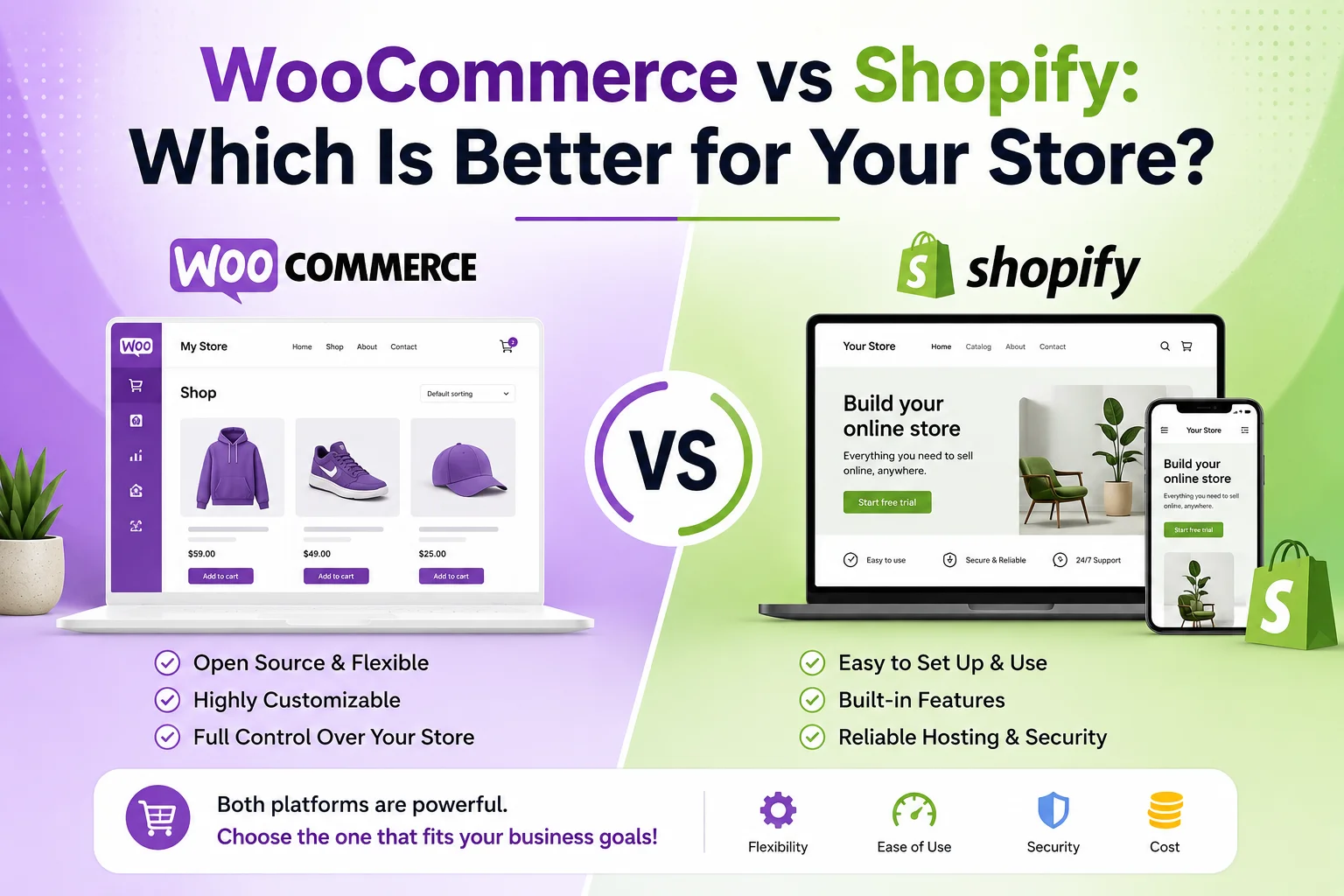
WooCommerce vs Shopify: Which Is Better for Your Store?
Choose WooCommerce if you want greater control, extensive customization, WordPress integration, and the ability to choose your own hosting and technical stack.
Choose Shopify if you want a simpler setup, managed hosting, centralized ecommerce tools, and less responsibility for technical maintenance.
For a content-heavy business that already relies on WordPress, WooCommerce can be a natural choice. For someone who wants to launch an ecommerce store quickly without managing hosting and WordPress, Shopify may be easier.
Your decision should ultimately be based on your business model rather than which platform is more popular.
How to Choose Between WooCommerce and Shopify
Before making your decision, ask these questions:
Do you already use WordPress?
If yes, WooCommerce may integrate more naturally with your existing website.
Do you want maximum customization?
WooCommerce generally gives you more control over the website environment.
Do you want less technical maintenance?
Shopify handles more of the infrastructure for you.
Do you have a limited technical background?
Shopify can provide a simpler starting point.
Do you need specialized ecommerce functionality?
Compare the available WooCommerce extensions and Shopify apps for the exact features your store needs.
For example, businesses selling products that require signing or approval workflows may consider specialized solutions such as WooCommerce Digital Signature functionality rather than relying only on standard ecommerce features.
If you’re building a WooCommerce store and need additional functionality, PluginOrbit can also be considered when evaluating WooCommerce-focused plugin solutions.
Conclusion
The WooCommerce vs Shopify decision ultimately comes down to how you want to run your ecommerce business.
WooCommerce is a strong choice for flexibility, customization, WordPress integration, and control. Shopify is a strong choice for simplicity, managed infrastructure, and faster store management.
If you want complete control over your website and are comfortable managing WordPress, WooCommerce can be the better fit. If you want an ecommerce-first platform that handles more of the technical infrastructure, Shopify may be the better option.
The best platform isn’t necessarily the one with the most features. It’s the one that fits your budget, technical skills, customization requirements, and long-term business goals.