eCommerce has changed how businesses sell products and services. From independent online stores to large marketplaces, businesses can choose from different ways to connect with customers, generate revenue, and manage sales.
eCommerce business models show how an online business operates, who it serves, and how it generates revenue. The most common models include B2B, B2C, C2C, C2B, D2C, and B2B2C. Choosing the right model is an important early step when you start an ecommerce business, as it can influence your target customers, sales strategy, operating costs, and long-term growth.
This article covers the Types of eCommerce Business Models, how each model works, practical examples, key benefits and challenges, and the factors to consider when choosing the right model for your business.
What Is an eCommerce Business Model?
eCommerce business models show how an online business operates, who it serves, and how it generates revenue. The most common models include B2B, B2C, C2C, C2B, D2C, and B2B2C.
In simple terms, it answers three important questions:
- Who is selling?
- Who is buying?
- How does the business make money?
For example, a manufacturer selling products directly to customers follows a different business model ecommerce approach than a wholesaler selling products to other businesses.
Your business model can influence your pricing, marketing strategy, customer relationships, sales channels, and operating costs.
What Are the Main Types of eCommerce?
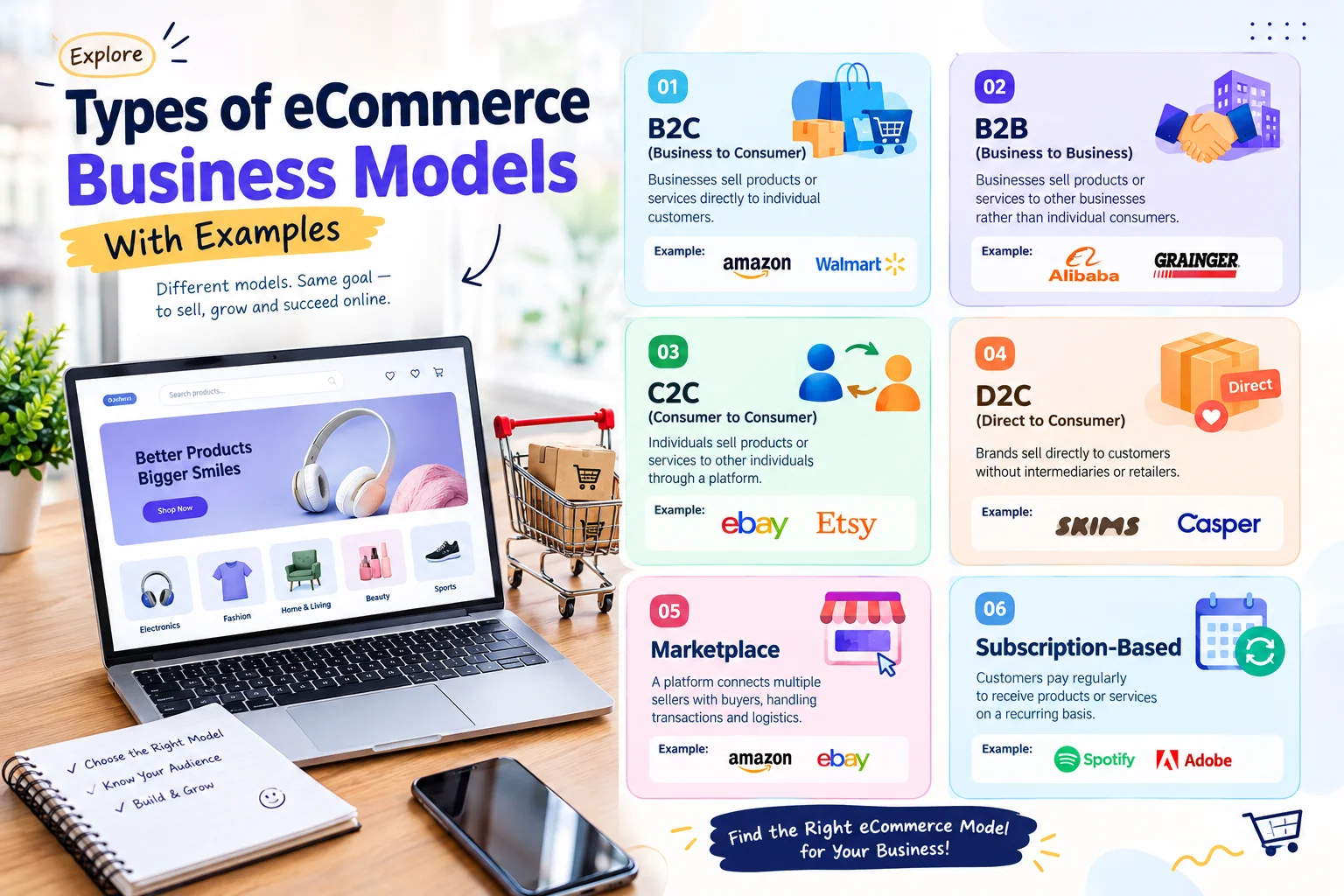
The major types of eCommerce business models are:
- B2B (Business-to-Business)
- B2C (Business-to-Consumer)
- C2C (Consumer-to-Consumer)
- C2B (Consumer-to-Business)
- D2C (Direct-to-Consumer)
- B2B2C (Business-to-Business-to-Consumer)
Other online business models, such as marketplaces, subscriptions, dropshipping, and wholesale, can also be used depending on the products, customers, and business strategy.
1. B2B eCommerce Business Model
B2B, or Business-to-Business, is an eCommerce model where one business sells products or services to another business.
For example, a manufacturer might sell packaging materials to an online retailer, or a software company might sell business software through an online platform.
How B2B eCommerce works
B2B businesses often handle larger orders and may offer custom pricing, bulk discounts, account-based purchasing, or recurring orders.
Example
A wholesale supplier selling inventory to retail businesses through an online ordering portal is using a B2B eCommerce model.
Advantages
- Larger order values
- Potential for recurring customers
- Long-term business relationships
- Opportunities for bulk sales
Challenges
- Longer sales cycles
- More complex purchasing decisions
- Customized pricing requirements
- Multiple decision-makers
B2B is generally suitable for manufacturers, wholesalers, distributors, SaaS companies, and businesses providing professional services.
2. B2C eCommerce Business Model
B2C, or Business-to-Consumer, is one of the most familiar types of eCommerce. In this model, a business sells products or services directly to individual consumers.
An online clothing store, electronics retailer, or beauty brand selling directly through its website is an example of B2C eCommerce.
How B2C eCommerce works
Customers visit an online store, browse products, add items to their cart, complete checkout, and receive their orders through delivery or digital fulfillment.
Businesses typically focus on product presentation, pricing, customer experience, promotions, reviews, and convenient checkout.
Advantages
- Large potential customer base
- Faster purchasing decisions
- Direct customer feedback
- Easy access to online marketing channels
Challenges
- High competition
- Customer acquisition costs
- Returns and refunds
- Customer service requirements
B2C can be a good choice for businesses selling consumer products, digital products, subscriptions, and services.
3. C2C eCommerce Business Model
C2C stands for Consumer-to-Consumer. It allows individuals to sell products or services directly to other individuals, usually through an online marketplace or platform.
For example, someone selling a used smartphone to another person through an online marketplace is participating in a C2C model.
How C2C eCommerce works
The platform typically provides tools for listing products, communication, payments, reviews, and sometimes shipping. The platform may generate revenue through listing fees, transaction commissions, advertising, or other charges.
Advantages
- Easy access to buyers and sellers
- Useful for second-hand products
- Lower barriers to selling
- Marketplace platforms can provide built-in traffic
Challenges
- Trust and fraud concerns
- Quality can vary between sellers
- Platform fees
- Limited control over customer relationships
C2C works particularly well for used goods, collectibles, handmade products, and peer-to-peer services.
4. C2B eCommerce Business Model
C2B, or Consumer-to-Business, reverses the traditional relationship. Instead of businesses offering products to consumers, individuals provide products, services, or value to businesses.
Freelancers, photographers, creators, consultants, and influencers can operate within a C2B model.
Example
A freelance designer creates a logo for a company and receives payment for the service. The individual is providing value directly to a business.
Advantages
- Flexible opportunities for individuals
- Businesses can access specialized talent
- Digital platforms make transactions easier
- Suitable for freelance and creator-based services
Challenges
- Income may be inconsistent
- Competition can be high
- Individuals may need to continuously find clients
- Pricing and negotiations can vary
C2B is particularly relevant to the growing freelance, creator, and digital services economy.
5. D2C eCommerce Business Model
D2C stands for Direct-to-Consumer. It allows manufacturers or brands to sell directly to customers without relying primarily on traditional distributors or retailers.
For example, a skincare brand that manufactures its products and sells them directly through its own website is following a D2C model.
Why D2C is popular
D2C gives brands greater control over pricing, branding, customer experience, and customer data. It can also help businesses build direct relationships with their customers.
Businesses that want to start ecommerce business operations around their own products may consider D2C because they can control more of the buying journey.
Advantages
- Direct customer relationships
- Greater control over brand experience
- More control over pricing
- Access to first-party customer data
- Opportunities for repeat purchases
Challenges
- Marketing costs
- Inventory and fulfillment responsibilities
- Customer support
- Logistics and returns
D2C is especially useful for consumer brands that want to build long-term relationships rather than depending entirely on third-party retailers.
6. B2B2C eCommerce Business Model
B2B2C stands for Business-to-Business-to-Consumer. It involves a business working with another business to ultimately reach the end customer.
For example, a technology provider might supply an eCommerce solution to a retailer, while the retailer sells products to consumers through that solution.
How B2B2C works
The first business provides products, technology, services, or infrastructure to another business. That partner then uses those resources to serve consumers.
Advantages
- Access to established customer channels
- Partnership opportunities
- Wider market reach
- Shared resources and capabilities
Challenges
- More complex relationships
- Revenue sharing
- Less direct control over the customer experience
- Dependence on business partners
B2B2C can work well when two businesses have complementary products, services, or audiences.
Other Online Business Models to Consider
The buyer-seller relationship is only one way to understand eCommerce. Businesses can also choose different operating and monetization approaches.
Marketplace Model
An online marketplace connects multiple sellers with buyers. The marketplace may earn money through commissions, listing fees, advertising, subscriptions, or transaction fees.
Subscription Model
Customers pay regularly, such as monthly or annually, to receive products or services. Subscription models can create predictable recurring revenue.
Dropshipping Model
The seller markets and sells products without keeping the inventory themselves. When an order is placed, a supplier typically handles fulfillment.
Wholesale Model
A business sells products in larger quantities to retailers or other businesses, usually at lower per-unit prices.
These approaches can sometimes be combined with B2B, B2C, D2C, or other core eCommerce models.
What Is an eCommerce Revenue Model?
An ecommerce revenue model explains how an online business generates income.
This is related to an eCommerce business model, but the two terms are not identical.
For example, a B2C online store is a business model, while selling products for a profit is one way that store can generate revenue.
Common eCommerce revenue models include:
- Product sales: Revenue comes from selling physical or digital products.
- Subscription fees: Customers pay recurring charges for continued access.
- Commission: A marketplace takes a percentage from transactions.
- Advertising: Businesses earn revenue by displaying advertisements.
- Transaction fees: Customers or sellers pay fees for processing transactions.
- Freemium: Basic features are free while advanced features require payment.
Understanding your revenue model is important because it affects pricing, customer acquisition, profitability, and long-term growth.
How Does an eCommerce Platform Fit Into the Business Model?
An ecommerce platform provides the technology businesses use to build and operate an online store. As businesses need more functionality, solutions from Plugin Orbit can help extend WordPress and WooCommerce stores with features tailored to different eCommerce requirements.
Depending on the platform, businesses may get features for:
- Product management
- Shopping carts
- Checkout
- Payment processing
- Order management
- Customer accounts
- Shipping
- Marketing integrations
- Analytics
Choosing a platform should come after understanding your business requirements. For example, a business planning a highly customized store may have different needs from a small company that wants to launch quickly.
If you are comparing major store-building options, an article about WooCommerce vs Shopify can help you understand how the two approaches differ.
Businesses that choose WooCommerce can also explore how to Online store on WooCommerce based on their product catalog, integrations, and operational requirements.
How to Choose the Right eCommerce Business Model
There is no single eCommerce model that works for every business. The right choice depends on your customers, products, resources, and growth strategy.
Consider these questions before choosing:
Who are your customers?
Determine whether you are selling to consumers, businesses, or both.
What are you selling?
Physical products, digital products, subscriptions, and services can require different operating models.
How will you generate revenue?
Consider whether your business will depend on direct product sales, subscriptions, commissions, advertising, or multiple revenue streams.
Do you need inventory?
If you sell physical products, decide whether you will manufacture, purchase, warehouse, or dropship inventory.
How much control do you want?
A D2C website can provide more control over branding and customer relationships, while a marketplace may provide access to an existing audience.
What are your long-term goals?
Think beyond launching the store. Consider customer retention, scalability, operating costs, technology requirements, and profitability.
eCommerce Business Models Compared
| Model | Seller | Buyer | Common Example | Suitable For |
| B2B | Business | Business | Wholesale supplier | Business sales |
| B2C | Business | Consumer | Online retailer | Consumer products |
| C2C | Consumer | Consumer | Online marketplace | Peer-to-peer sales |
| C2B | Consumer | Business | Freelancer | Digital services |
| D2C | Brand/Manufacturer | Consumer | Direct brand store | Consumer brands |
| B2B2C | Business + Partner | Consumer | Partner-based commerce | Expanded reach |
The best model depends on the relationship you want to build with customers and how you plan to deliver value.
Conclusion
Choosing the right eCommerce business model can shape how your business attracts customers, manages operations, generates revenue, and grows over time. Whether you choose B2B, B2C, C2C, C2B, D2C, or B2B2C, the best option depends on your target audience, products or services, resources, pricing strategy, and long-term goals.
Start with the customer relationship you want to build, then select the sales channels, technology, and revenue approach that support it. A practical approach can help you create an online business that is easier to manage and positioned for sustainable growth.
As your store grows, improving the customer journey becomes equally important. Features such as a Digital signature for checkout can add a confirmation step to transactions where customer approval or signed agreements are required.
Combined with a suitable eCommerce platform and a well-planned business model, these improvements can create a smoother buying experience while supporting more efficient store operations.