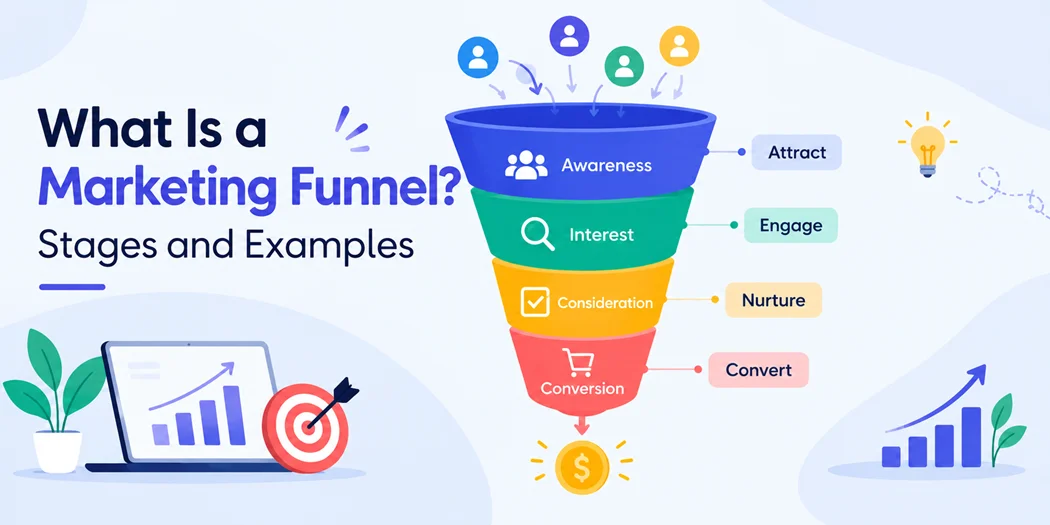
A marketing funnel is the journey a potential customer takes from first discovering a business to becoming a customer and, ideally, returning for another purchase. It helps businesses understand what people need at different points in their buying journey and create the right experience for each stage.
For example, someone might discover an online store through a Google search, visit a product page, compare options, add an item to their cart, and eventually complete the purchase. If they leave without buying, a follow-up email or another useful interaction may bring them back.
Understanding the marketing funnel makes it easier to turn website traffic into meaningful actions instead of simply trying to attract more visitors.
What Is a Marketing Funnel?
A marketing funnel is a framework used to describe how people move from being unfamiliar with a business to becoming customers.
The funnel is usually shown as a series of stages because not everyone who visits a website is ready to buy immediately. Some visitors are discovering a problem for the first time. Others are researching solutions, comparing products, or deciding whether a particular business is trustworthy.
A simple marketing funnel looks like this:
Awareness → Interest → Consideration → Conversion → Retention
The exact names and number of stages can vary depending on the business. A B2B company, ecommerce store, SaaS business, and service provider may structure their funnels differently.
The important idea is to understand the customer’s needs at each step and provide relevant information or actions that help them move forward.
How Does a Marketing Funnel Work?
A marketing funnel works by matching your marketing and website experience to the customer’s level of awareness and intent.
Imagine an online store selling productivity products.
A potential customer searches for ways to improve their home-office setup. They discover a helpful article and become aware of the brand. Later, they explore products, read descriptions and reviews, and compare options. When they are ready, they add a product to the cart and complete the checkout.
The journey might look like:
Search → Educational content → Product page → Cart → Checkout → Purchase → Follow-up
Each step has a different purpose.
At the awareness stage, the goal is to help people discover your business. During consideration, the goal is to answer questions and build confidence. At conversion, the focus shifts toward making the purchase process clear and convenient. After the purchase, retention activities can encourage customers to return.
This is why a marketing funnel is more than a list of marketing tactics. It is a way to think about the entire customer journey.
Marketing Funnel Stages
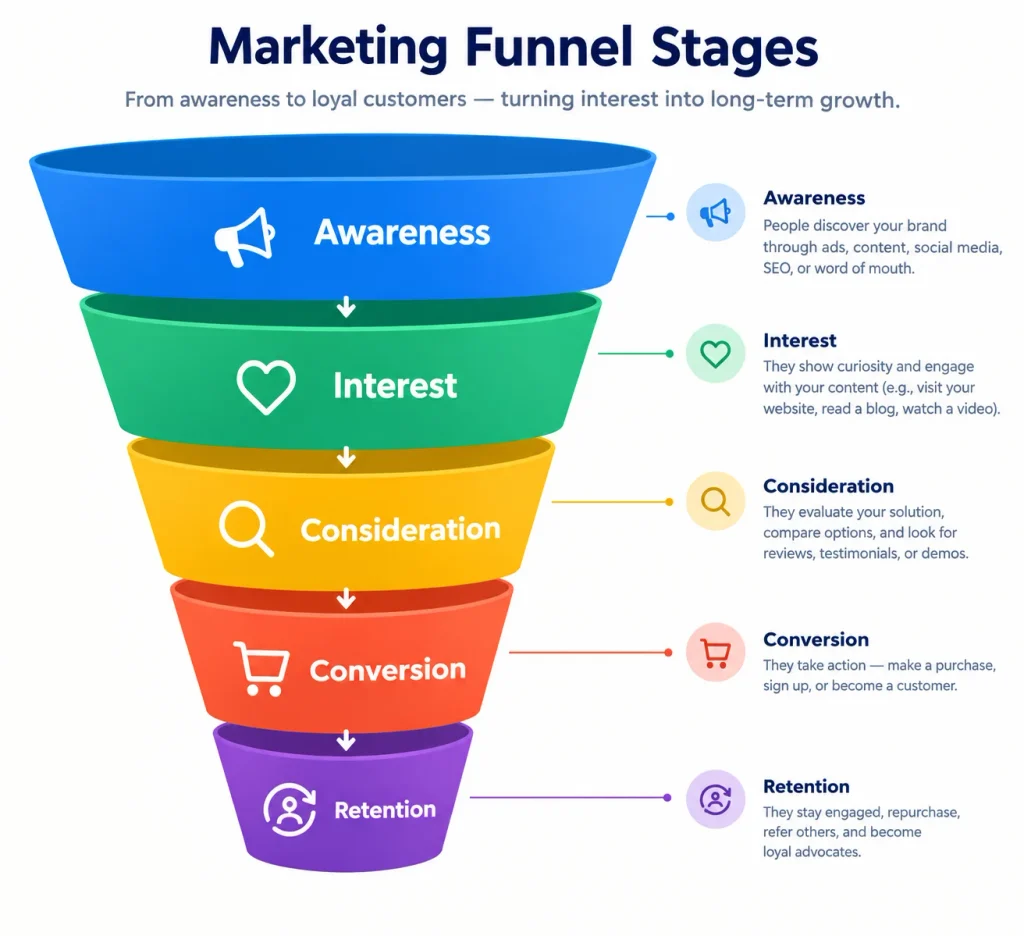
1. Awareness
Awareness is the top of the funnel.
At this stage, people may not know your business or may only be beginning to recognize a problem they want to solve.
Common awareness channels include:
- Search engines
- Blog content
- Social media
- Videos
- Podcasts
- Online communities
- Referrals
- Educational resources
For example, someone searching for “how to improve an online store” may discover an educational article before they are ready to purchase anything.
The goal at this stage is not necessarily to make an immediate sale. It is to provide useful information and give the visitor a reason to continue exploring.
2. Interest
Once someone knows about your business, they may become interested in what you offer.
They might read additional articles, subscribe to an email list, explore your website, or compare different solutions.
At this point, useful content can include:
- Detailed guides
- Product comparisons
- Tutorials
- Case studies
- Webinars
- Email newsletters
- Product education
The objective is to answer the visitor’s questions and make it easy for them to understand whether your solution is relevant.
3. Consideration
During the consideration stage, the visitor is actively evaluating options.
For an ecommerce business, this could mean visiting product pages, comparing products, checking pricing, reading reviews, and looking at shipping or return information.
This is where your website experience becomes especially important.
A clear product page should explain what the product does, who it is for, its important features, pricing, and what the customer should do next.
If you’re building an online store, learning how to Customize a WooCommerce Product Page can help you create a clearer product experience.
Trust also matters at this stage. Transparent policies, accurate product information, customer reviews, useful FAQs, and clear contact information can reduce uncertainty.
4. Conversion
Conversion is the point where a visitor completes the action you want them to take.
For an ecommerce store, that action is usually a purchase. For another business, it might be submitting a form, booking a consultation, starting a trial, or signing up for a service.
A strong conversion experience removes unnecessary friction.
For example:
- Keep the call to action clear.
- Make important information easy to find.
- Avoid unnecessary checkout steps.
- Provide familiar payment options.
- Make shipping and return information clear.
- Ensure the site works well on mobile devices.
The objective is not to pressure people into buying. It is to make it easy for a customer who has already decided to act.
5. Retention
The funnel does not necessarily end after the first purchase.
A good customer experience can encourage people to return, recommend your business, or purchase additional products.
Retention can include:
- Helpful post-purchase emails
- Product education
- Customer support
- Loyalty programs
- Relevant offers
- Reorder reminders
- Feedback requests
Abandoned-cart recovery is another useful part of the ecommerce customer journey. If someone adds a product to their cart but leaves before completing checkout, an appropriate follow-up can remind them about the unfinished purchase without being intrusive.
Marketing Funnel Examples
Example 1: Ecommerce Funnel
Consider a WooCommerce store selling fitness equipment.
The customer journey could look like:
Google search → Fitness guide → Product category → Product page → Add to cart → Checkout → Purchase → Follow-up
The educational guide attracts people who are researching. Product pages help visitors evaluate their options. Checkout handles the transaction, while post-purchase communication helps build the relationship.
If you’re new to ecommerce, you can also explore our guide on how to Start an eCommerce Business.
Example 2: Service Business Funnel
A web design agency might use a different funnel:
Search or social media → Blog article → Service page → Case study → Consultation form → Sales call → Client
Here, the conversion is not an immediate online purchase. The funnel helps a visitor move from learning about a problem to becoming comfortable enough to contact the company.
Example 3: Content-to-Email Funnel
A business might offer a useful downloadable guide in exchange for an email address:
Search → Blog post → Free resource → Email signup → Educational emails → Product/service offer
This approach gives the business an opportunity to continue providing value after the visitor leaves the original page.
What Are the Types of Marketing Funnels?
There is no single funnel that works for every business. Different businesses may use different types of marketing funnels depending on their goals and buying process.
Lead Generation Funnel
A lead-generation funnel focuses on turning visitors into leads, often through a form, newsletter signup, consultation request, or downloadable resource.
Ecommerce Funnel
An ecommerce funnel is designed around online purchasing. It often includes product discovery, product evaluation, cart, checkout, purchase, and retention.
Content Marketing Funnel
A content funnel uses educational content to attract visitors and gradually move them toward an action such as subscribing, requesting information, or purchasing.
Email Marketing Funnel
An email funnel uses a sequence of relevant messages to educate subscribers, build trust, and encourage a desired action.
Sales Funnel
A sales funnel focuses more specifically on the process of moving prospects toward a purchase. Marketing and sales funnels often overlap, and businesses may use the terms differently.
The best approach is to choose a funnel structure that reflects how your customers actually make decisions rather than forcing your business into a fixed template.
How to Build a Marketing Funnel
Building a useful marketing funnel starts with the customer, not the software.
Step 1: Define Your Target Customer
Identify who you are trying to help.
Consider their:
- Problems
- Goals
- Questions
- Buying concerns
- Budget
- Existing knowledge
- Preferred channels
A clear customer profile makes the rest of the funnel easier to design.
Step 2: Define the Desired Conversion
Decide what action you want people to take.
It might be:
- Buying a product
- Requesting a quote
- Booking a call
- Joining an email list
- Starting a free trial
- Downloading a resource
Without a clear conversion goal, it is difficult to measure whether your funnel is working.
Step 3: Create Content for Each Stage
Don’t give every visitor the same message.
Someone discovering a problem may need an educational article, while someone comparing products may need specifications, reviews, demonstrations, or pricing information.
Map your content to the questions customers ask at each stage.
Step 4: Build the Website Journey
Make sure visitors can move logically from one step to the next.
For a WooCommerce store, that could mean:
Content → Category → Product → Cart → Checkout → Confirmation
Your navigation, calls to action, product information, and checkout experience should support that journey.
If you use WordPress and WooCommerce, choosing the right WooCommerce plugins can extend your store’s functionality. However, plugins should solve genuine customer or business needs rather than being added simply because they are available.
Step 5: Reduce Friction
Look for places where customers hesitate or abandon the process.
Ask:
- Is the next step obvious?
- Is the page easy to understand?
- Are important questions answered?
- Is checkout unnecessarily complicated?
- Are there unexpected costs?
- Does the site work properly on mobile?
Small improvements can make the customer journey easier.
Step 6: Measure and Improve
A funnel should be treated as an ongoing process.
Track meaningful metrics such as:
- Traffic
- Engagement
- Lead conversion rate
- Add-to-cart rate
- Checkout completion rate
- Purchase conversion rate
- Customer retention
If many visitors reach a product page but few add an item to their cart, investigate the product page. If many customers add products but abandon checkout, examine the checkout experience.
Data helps you identify where people are getting stuck.
How Abandoned Carts Fit Into an Ecommerce Funnel
Not every customer who reaches the checkout will complete a purchase.
An abandoned cart occurs when someone adds products to their cart but leaves before completing the transaction. This creates an opportunity for abandoned cart recovery.
A thoughtful recovery process might send a reminder after a suitable period, answer common questions, or provide a helpful reason to return.
The goal should be to assist the customer rather than repeatedly pressure them.
For example:
Product viewed → Product added to cart → Checkout started → Customer leaves → Reminder → Customer returns → Purchase
This is one reason funnel optimization should not stop at the first conversion. Understanding where customers leave the journey can reveal practical opportunities to improve the overall experience.
How to Improve a Marketing Funnel
Once your funnel is running, look for evidence rather than guessing.
Start by identifying the stage with the largest drop-off.
For example:
- High traffic + low engagement → Improve content relevance.
- High engagement + few product visits → Improve calls to action or navigation.
- Many product views + few add-to-carts → Improve product information and trust.
- Many carts + low completed purchases → Investigate checkout friction.
- Good first purchases + poor repeat purchases → Improve retention and post-purchase experience.
Avoid changing everything at once. Test one meaningful improvement, measure the result, and then decide what to change next.
Conclusion
A marketing funnel is ultimately a way to understand how people move from discovering your business to taking meaningful action.
The most effective funnel is not necessarily the most complicated one. Start with your customer’s needs, create useful information for each stage, remove unnecessary friction, and measure what happens along the journey.
For an ecommerce website, the process might be as simple as:
Discover → Learn → Compare → Purchase → Return
Once you understand where customers enter, where they hesitate, and what helps them move forward, you can make better decisions about your content, website experience, and marketing strategy.
The goal isn’t to push every visitor toward a sale. It is to give the right person the right information and experience at the right time.