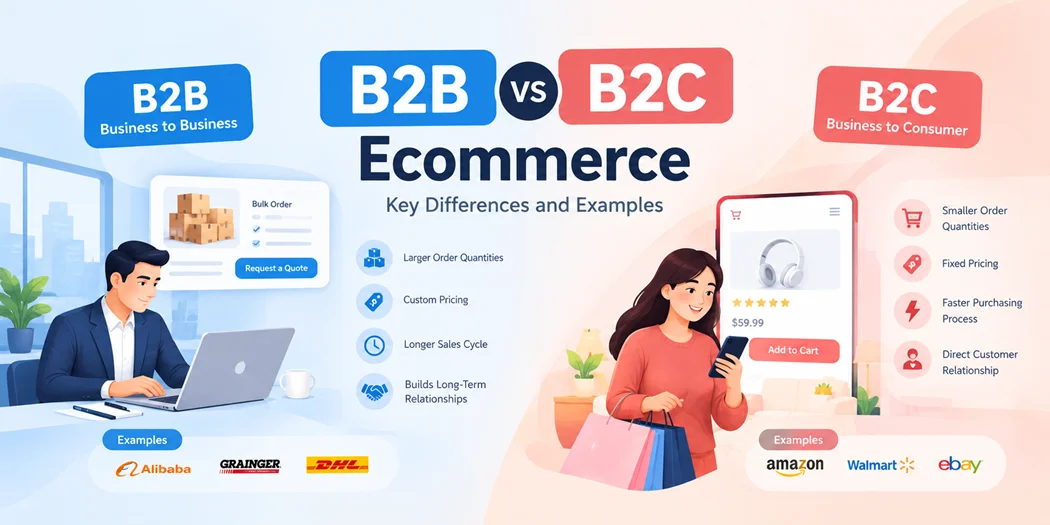
B2B and B2C ecommerce both involve selling products or services online, but they are designed for different types of buyers. B2B ecommerce means a business sells to another business, while B2C ecommerce means a business sells directly to individual consumers.
The difference goes beyond who places the order. Pricing, order volume, sales cycles, customer relationships, payment methods, and website functionality can all change depending on the type of customer you serve.
If you plan to start an ecommerce business, understanding these differences can help you choose the right business model and build a store around your customers’ needs.
For example, a manufacturer selling 500 products to a retailer is operating under a B2B model. An online clothing store selling one shirt directly to a shopper is using a B2C model.
Understanding B2B vs B2C Ecommerce can help you choose the right business model, website experience, marketing approach, and ecommerce platform for your target audience.
What Is B2B Ecommerce?
B2B ecommerce, or business-to-business ecommerce, is an online selling model where one business sells products or services to another business.
A manufacturer may sell components to another company, a wholesaler may supply products to retailers, or an office supplier may sell equipment to organizations.
Unlike many consumer purchases, B2B transactions can involve multiple people and business requirements. A buyer may need approval from a manager, compare suppliers, request a quote, or negotiate pricing before placing an order.
Common B2B ecommerce requirements include:
- Bulk ordering
- Wholesale pricing
- Customer-specific pricing
- Business accounts
- Quote requests
- Purchase orders
- Invoicing
- Repeat ordering
- Account management
The goal is often not just to complete one transaction but to create an efficient purchasing process that supports ongoing business relationships.
What Is B2C Ecommerce?
B2C ecommerce, or business-to-consumer ecommerce, is an online model where a business sells directly to individual customers.
This is the ecommerce experience most consumers use every day. A shopper visits an online store, searches for a product, checks its details, adds it to the cart, completes checkout, and receives the order.
Common B2C ecommerce businesses include:
- Clothing stores
- Electronics retailers
- Beauty brands
- Furniture stores
- Grocery websites
- Subscription businesses
- Direct-to-consumer brands
B2C stores usually focus heavily on convenience. Product images, reviews, promotions, search, product recommendations, mobile usability, and a simple checkout can all influence the customer’s decision.
B2B vs B2C Ecommerce: Key Differences
The main B2B vs B2C differences come from the type of customer and how that customer makes a purchase.
| Factor | B2B Ecommerce | B2C Ecommerce |
| Customer | Business | Individual consumer |
| Purchase purpose | Business use or resale | Personal use |
| Order volume | Often larger | Usually smaller |
| Pricing | May vary by customer or quantity | Usually standard |
| Decision-making | May involve several people | Often one person |
| Sales cycle | Can be longer | Often shorter |
| Payment | Invoices, terms, purchase orders | Cards, wallets, online payments |
| Customer relationship | Often ongoing | Often transaction or loyalty focused |
| Reordering | Frequently structured | Depends on the product |
| Website experience | Account and workflow focused | Convenience and conversion focused |
These differences are general patterns rather than strict rules. Some B2B orders are simple, while some B2C purchases can involve extensive research and high spending.
1. Customer Type
The most obvious difference between B2B vs B2C is the buyer.
A B2B business sells to companies, retailers, manufacturers, distributors, or other organizations. A B2C business sells directly to individual consumers.
This distinction affects the rest of the customer journey.
A business buyer may care about product specifications, quantity, delivery schedules, pricing agreements, and long-term supplier reliability.
A consumer may care more about price, reviews, convenience, product quality, shipping, and brand experience.
2. Buying Decision
B2B purchasing decisions can involve several stakeholders.
For example, an employee may identify a product, a department manager may approve the purchase, and a finance or procurement team may complete the transaction.
B2C purchasing is often more direct. One shopper can discover a product, evaluate it, and complete the purchase without needing approval from another person.
This is why B2B websites often need features that support account-based purchasing and internal workflows.
3. Pricing and Discounts
Pricing is another important difference.
B2C ecommerce commonly uses publicly displayed prices. Discounts may be offered through coupons, seasonal sales, bundles, loyalty programs, or promotions.
B2B pricing can be more flexible. A business may receive different prices based on order quantity, customer type, negotiated agreements, or purchasing volume.
For example, a consumer might purchase one item at the standard retail price, while a retailer ordering hundreds of units could receive a wholesale price.
4. Order Size
B2B customers frequently purchase larger quantities because products may be used for business operations or resold to customers.
A retailer might purchase hundreds of products from a supplier. A restaurant may regularly order packaging supplies. A manufacturer may purchase components for production.
B2C shoppers generally purchase smaller quantities for personal use.
However, order size alone does not determine the business model. A consumer can make an expensive purchase, and a small business can make a small order.
5. Sales Cycle
The B2B vs B2C sales process can also be very different.
A typical B2C journey may look like:
Search → Product page → Add to cart → Checkout → Payment
A B2B purchasing journey may look like:
Research → Product evaluation → Quote → Approval → Purchase → Reorder
B2B customers may need more product documentation, pricing information, account support, and purchasing options before they are ready to place an order.
B2C stores generally try to reduce friction and help shoppers complete their purchase quickly.
6. Customer Relationships
B2B businesses often depend on long-term customer relationships.
A retailer may purchase from the same supplier every month. A company may have an ongoing contract with a software provider or equipment supplier.
B2C businesses can also build long-term relationships, but they often focus on brand loyalty, repeat purchases, personalized offers, customer support, and retention.
Both models benefit from a positive customer experience, but the relationship structure can be different.
B2C Ecommerce Examples
Looking at practical B2C ecommerce examples makes the model easier to understand.
Online Fashion Store
A clothing brand sells dresses, shirts, shoes, and accessories directly to consumers.
The customer can browse products, select a size, read reviews, add an item to the cart, and complete checkout.
This is a typical B2C ecommerce journey.
Electronics Store
An online electronics business sells headphones, laptops, cameras, or accessories directly to shoppers.
Customers may compare specifications, prices, reviews, and delivery options before purchasing.
Subscription Brand
A skincare, food, or household brand may offer products directly to consumers through recurring subscriptions.
The business focuses on convenience, product value, customer retention, and repeat purchasing.
B2B Ecommerce Examples
There are many types of B2B ecommerce examples, from manufacturers to wholesalers.
Wholesale Supplier
A wholesaler sells products in large quantities to retail stores.
The retailer may have a business account, receive volume pricing, and reorder products regularly.
Manufacturer
A manufacturer sells components or materials to another company.
The buyer may require technical specifications, negotiated pricing, minimum order quantities, and scheduled deliveries.
Business Equipment Supplier
An office equipment company sells desks, computers, printers, or other supplies to organizations.
The purchasing process may involve multiple employees and a formal approval process.
B2B vs B2C Sales: How Does the Process Differ?
The sales process is one of the most important areas to consider when comparing B2B and B2C ecommerce.
B2C sales often depend on helping a customer move from product discovery to purchase with as little friction as possible.
Useful B2C elements include:
- Clear product information
- Reviews
- Promotions
- Product recommendations
- Simple checkout
- Multiple payment options
- Mobile-friendly shopping
B2B sales may require additional information and functionality, such as:
- Detailed product specifications
- Bulk pricing
- Quote requests
- Customer accounts
- Purchase orders
- Approval workflows
- Repeat ordering
The important point is that neither model follows one universal sales process. Your website should reflect how your specific customers actually buy.
What Do B2B and B2C Ecommerce Have in Common?
Although B2B ecommerce and B2C ecommerce have different audiences, they share many basic requirements.
Both need:
- A reliable ecommerce website
- Clear product information
- Search and navigation
- Secure payments
- Order management
- Shipping options
- Customer support
- Mobile-friendly design
- Website performance
- A simple purchasing experience
The difference is mainly in how these features are implemented.
For example, both B2B and B2C stores need checkout functionality. However, a B2B checkout may need purchase orders or account-specific pricing, while a B2C checkout may focus on speed and payment convenience.
Can a Business Be Both B2B and B2C?
Yes. A business can serve both audiences.
For example, a manufacturer could sell bulk products to retailers while also selling individual products directly to consumers through its website.
The business may need separate:
- Pricing structures
- Customer accounts
- Product quantities
- Catalogs
- Payment methods
- Checkout requirements
A hybrid approach can be useful when a business has both professional buyers and individual consumers.
The important thing is to make each customer journey clear so that buyers see the products, prices, and purchasing options relevant to them.
Choosing an Ecommerce Platform for B2B or B2C
Your ecommerce platform should support the way your customers actually shop.
If you are still deciding how your business will operate, reviewing different ecommerce business models can help you understand how customer type, products, revenue, and purchasing behavior fit together.
Once you have identified your audience and business model, you can start an ecommerce business around the products, pricing, fulfillment, and customer experience your market expects.
For businesses considering WordPress, understanding what WooCommerce is can help you evaluate how the platform supports products, payments, orders, extensions, and store customization.
If you are comparing ecommerce platforms, reviewing WooCommerce vs Shopify can help you assess differences in customization, store management, and available functionality.
For a WooCommerce store, WooCommerce plugins can extend the website with additional functionality based on specific business requirements.
The right platform ultimately depends on your products, customers, operations, budget, and required features.
How to Decide Between B2B and B2C Ecommerce
Start with one basic question:
Who is your customer?
If you primarily sell to businesses, your website may need features designed around business purchasing.
If you sell directly to consumers, your priority may be a simple and convenient shopping experience.
Consider these questions before choosing your model:
- Who purchases your products?
- Are customers buying for personal or business use?
- Do customers need bulk quantities?
- Will different customers require different prices?
- How long does it take to make a purchase?
- Are multiple people involved in approval?
- Do customers need quotes or purchase orders?
- Will customers reorder frequently?
- What payment methods do they expect?
Your answers can help you determine which ecommerce structure and website functionality make sense for your business.
Conclusion
The biggest B2B vs B2C Ecommerce difference is the customer and the way that customer makes purchasing decisions.
B2B ecommerce is generally built around business customers, recurring relationships, larger or structured orders, and purchasing requirements such as quotes, approvals, or negotiated pricing.
When choosing an ecommerce platform for these requirements, comparing WooCommerce vs Shopify can also help you evaluate factors such as customization, pricing options, and available store functionality.
Both models need a reliable ecommerce foundation and a customer experience that makes buying straightforward.
Before choosing an ecommerce platform, define your audience, understand the purchasing journey, and identify the features your customers actually need. From there, you can build an ecommerce experience that fits your business model instead of forcing your customers into a process that does not match how they buy.