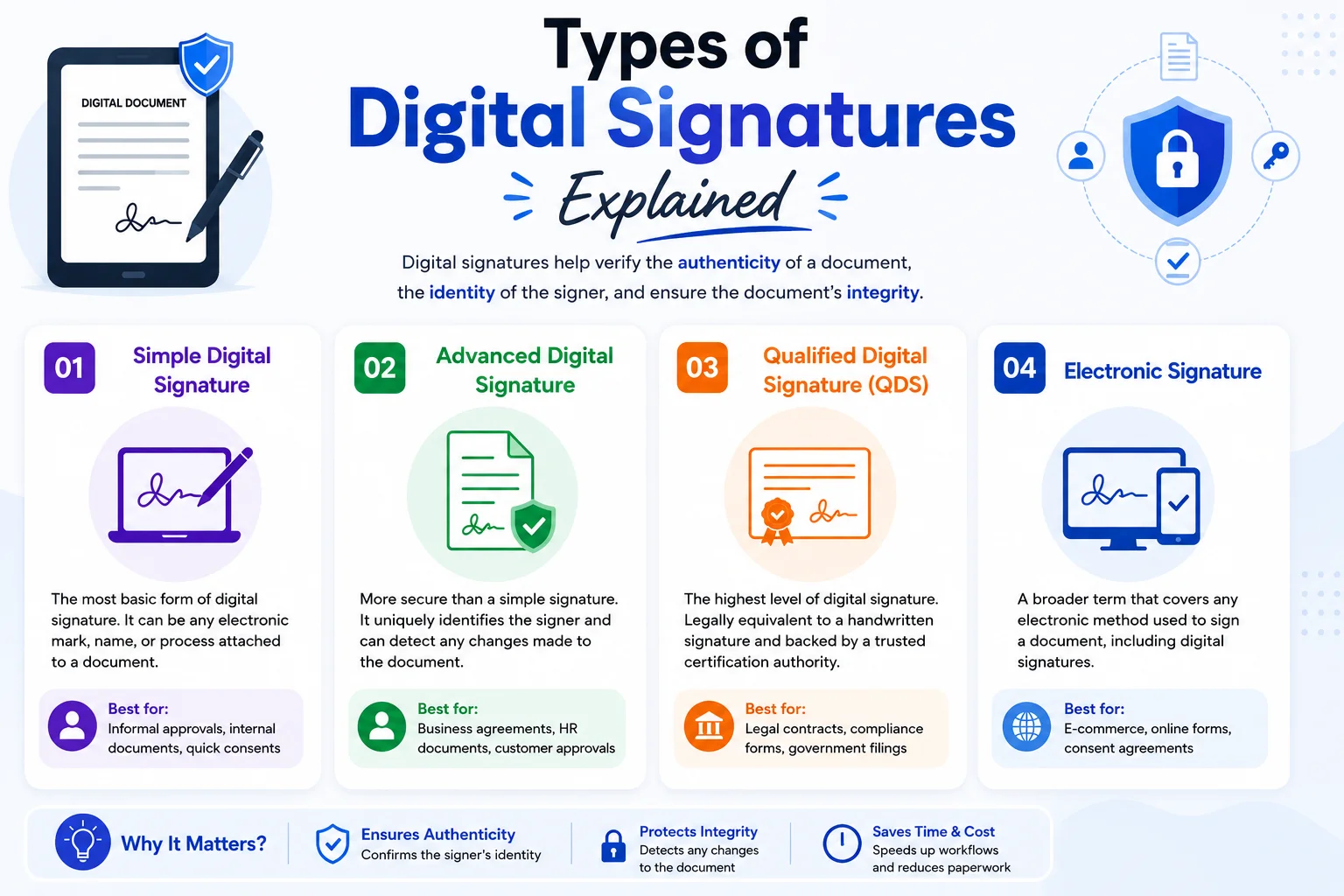
Digital signatures help people and businesses sign electronic documents while verifying the signer and protecting the document from unwanted changes. However, different digital signing methods offer different levels of security, identity verification, and document protection.
Exploring the types of digital signatures makes it easier to choose the right signing method for your needs. This digital signature guide covers the key factors to consider, including what you are signing, who needs to sign it, and how much security or verification is required.
Here, we cover the main digital signature types, how they work, what makes them different, and how to choose the right option for your workflow.
What Are the Types of Digital Signatures?
Digital signatures can be categorized according to how the signer is authenticated, how signing credentials are managed, and the level of assurance required.
The exact classification can vary depending on the technology, legal framework, certification system, or country involved. For that reason, there is no single universal list that applies to every digital-signing environment.
At a practical level, digital signatures can be understood through differences in:
- Signer identification
- Authentication requirements
- Digital certificates
- Cryptographic security
- Verification methods
- Document integrity
- Regulatory or organizational requirements
This distinction is important because choosing a signing method should depend on the risk and purpose of the transaction rather than simply selecting the most advanced-sounding option.
Digital Signature Types Explained
Different digital signature methods can provide different levels of identity assurance and security. The terminology used to describe them may also vary between providers and jurisdictions.
Basic Digital Signing Methods
Some digital signing workflows focus primarily on capturing a person’s intent to sign electronically.
Depending on the platform, the signer may authenticate through an account, email verification, access code, or another method before completing the signing process.
These approaches can be suitable for everyday business workflows where the organization needs a convenient way to collect approvals or acknowledgements.
Certificate-Based Digital Signatures
Certificate-based signatures use a digital certificate to associate a public key with an identified signer.
The certificate provides information that can be used during signature verification, while cryptographic keys help protect the signed content.
This approach is commonly relevant when stronger signer authentication and document integrity are important.
Higher-Assurance Digital Signatures
Some signing environments require additional identity verification or stronger controls around the signing credentials.
The exact requirements depend on the applicable regulation, industry, organization, and signing service. In higher-risk workflows, businesses may need stronger identity checks, trusted certificates, secure signing devices, or additional audit information.
The key point is that digital signature types are not defined only by how a signature looks on a document. The underlying authentication and cryptographic process is what determines its security characteristics.
Different Types of Digital Signature Classification
A common source of confusion is the use of terms such as Class 1, Class 2, and Class 3 digital signatures.
These classifications have been used in certain certificate and digital-signature environments, particularly in India, but terminology and regulatory requirements can change over time.
Therefore, businesses should verify the current requirements that apply to their country, certificate provider, and intended use instead of relying on older classifications found in outdated articles.
Rather than choosing a certificate solely because it belongs to a particular class, consider what the signing workflow actually requires:
- How strongly must the signer be identified?
- What type of document is being signed?
- Is the transaction legally or commercially sensitive?
- Does the workflow require a certificate?
- How will the signature be verified?
- What records need to be retained?
This approach makes the decision more practical and reduces the risk of choosing a signing method based only on terminology.
How Do Digital Signing Methods Work?
Although different implementations can vary, a cryptographic digital signature generally follows a structured process.
First, the document is prepared for signing. The system creates a unique mathematical representation of the document, commonly called a hash.
The signer then uses a private cryptographic key to create the signature associated with that information.
When the recipient receives the signed document, the signature can be checked using the corresponding public information.
The verification process helps determine whether the signature is valid and whether the document has changed since it was signed.
This is why digital signature verification is an important part of a trusted signing workflow.
If the document content changes after signing, the verification result can indicate that the signed content is no longer in its original state.
What Is Digital Signature Verification?
Digital signature verification is the process of checking whether a digital signature is valid and whether the associated document has remained intact.
A typical verification process can evaluate information such as:
- Whether the signature was created using the expected cryptographic credentials
- Whether the document content matches the signed information
- Whether the certificate is valid, where applicable
- Whether the certificate or signing credentials can be trusted
- Whether the signature has been revoked or otherwise invalidated
Verification is important because a visible signature alone does not prove that a document is authentic.
For example, an image of someone’s handwritten signature can be copied into another document. Cryptographic signing works differently because the signature is mathematically associated with the signed content.
How to Choose the Best Digital Signature
There is no single best digital signature for every situation.
The right option depends on the type of transaction, the required level of assurance, the people signing the document, and any applicable legal or organizational requirements.
Before selecting a signing solution, consider:
Identity Requirements
Determine how confidently you need to establish the signer’s identity. A simple customer approval may require a different process from a regulated financial or legal transaction.
Security Requirements
Consider whether the workflow needs certificate-based signing, stronger authentication, protected signing credentials, or additional verification controls.
Document Sensitivity
A routine internal approval may have different requirements from a contract, financial document, or legally significant agreement.
User Experience
A highly secure workflow that customers cannot easily complete may create unnecessary friction. The signing process should provide an appropriate balance between assurance and usability.
Compliance Requirements
Legal and regulatory requirements vary by country, industry, and document type. If compliance is important, confirm the requirements that apply to your specific use case.
Digital Signatures in Business and Ecommerce
Digital signatures are not limited to traditional contracts. Businesses can incorporate signing into online forms, approval systems, customer workflows, and ecommerce processes.
For example, an online store may need a customer to approve a customized product, confirm an agreement, or authorize a particular order before fulfillment.
You can also explore more about digital signature in ecommerce to understand where signing can fit into online purchasing and approval processes.
In these cases, a signing workflow can become part of the wider customer journey rather than a separate document-handling task.
For businesses using WooCommerce, a WooCommerce signature plugin can help connect digital signing functionality with ecommerce workflows where customer approval or acknowledgement is required.
Digital Signature vs Electronic Signature
Digital signatures and electronic signatures are related concepts, but they should not automatically be treated as identical.
An electronic signature is a broad concept covering different electronic methods used to indicate a person’s intent to sign.
If you want a deeper comparison, see our guide to digital signature vs electronic signature.
A digital signature is a more specific technical mechanism that uses cryptography to support signer authentication and document integrity.
For example, typing a person’s name into an online form may function as an electronic signature, while a certificate-based cryptographic signature uses keys and verification mechanisms.
The appropriate method depends on the purpose of the transaction and the security or legal requirements involved.
How to Add a Digital Signature to Your Workflow
Once you understand the available options, implementation becomes the next consideration.
A typical digital signing workflow may include:
- Preparing the document or form.
- Identifying the signer.
- Selecting the appropriate signing method.
- Requesting the signature.
- Completing authentication and signing.
- Verifying the resulting signature.
- Storing the signed document and relevant records.
The exact process will depend on the platform and the level of assurance required.
For website owners, digital signing can also be connected with forms, checkout processes, customer approvals, and other online workflows. If you’re looking to add a digital signature to a website, consider the signing requirements first rather than choosing a tool based only on its feature list.
Conclusion
The types of digital signatures are less about memorizing a list of labels and more about understanding how each signing approach establishes identity, protects document integrity, and supports a particular business or legal workflow.
Before choosing a method, evaluate the required level of authentication, security, compliance, document sensitivity, and user experience. For ecommerce workflows, a WooCommerce signature plugin can help align signing with your transaction requirements.
For organizations moving more approvals and transactions online, choosing the right digital signing approach can make document workflows easier to manage while providing stronger evidence of authenticity and integrity.